The Platform / Domains / Software Lifecycle
XOPS continuously maintains the Software Position across technical, commercial and business evidence, then executes governed actions as conditions change.
No new XOPS agent
Uses telemetry already deployed
Coexist or replace
Consume the existing ELP or maintain the Position directly
Weeks
To first production Outcome
The category shift
XOPS is not another SAM platform.
It maintains the Software Position across the systems you already run.
Technical Position
Installed · Deployed · Used · Entitled
Commercial Position
Purchased · Contracted · Financially exposed
Business Position
Owned · Required · Operationally critical
SOFTWARE POSITION
Determine the next action
Provision · Reclaim · Remediate · Renew · Forecast · Audit
Four things change when a report becomes a Position. Inventory records; XOPS determines from the Position. Baselines expire the moment the review ends; a Position persists, continuously reconciling new evidence from identity, endpoints, SaaS platforms, contracts, procurement, and the business. Reports are rebuilt on a schedule; a Position publishes continuously — the ELP, compliance view, reclamation report, and executive brief all stay current because they draw from the same maintained evidence. And where reports recommend, XOPS acts from the maintained Position: provisioning, reclaiming, remediating, renewing, forecasting, and producing audit evidence directly.
None of this requires a new proprietary endpoint agent. If you run Flexera or ServiceNow SAM Pro Plus today, you already get a baseline or an ELP — what you’re used to doing next is correlating that output against identity, ownership, usage, and contracts by hand, every renewal, every audit, every reorg. XOPS removes that manual step: it reconciles software evidence already collected by EDR, MDM, DEX, identity, SaaS platforms, and procurement systems, so it can consume an existing Flexera or ServiceNow ELP as one input, or, where enterprise telemetry is already sufficient, derive and maintain the Software Position directly without a separate discovery layer.
Coexist
Flexera or ServiceNow gives you the baseline. XOPS does the correlation work your team used to do by hand — matching it to identity, contracts, usage, ownership, and business context — continuously, not just at renewal time.
Replace
XOPS adds no discovery layer of its own to stand up, normalize and operate. It derives and maintains the Software Position from telemetry your identity, endpoint, SaaS and procurement systems already produce — including the usage signal that makes a reclamation defensible.
HR
Identity
Provisioning
License
Vendor
Audit
Renewal
Finance
Legacy SAM optimizes individual licenses. XOPS maintains one Software Position — technical, commercial, and business — for every product and vendor relationship, reclaiming licenses in real time on offboarding, auto-provisioning 82% of grants through SCIM and API, and recovering roughly 25% of license waste in year one.
That Position is not another dashboard: it is the continuously maintained evidence base behind every operational, compliance, financial, and executive view of the software estate — one evidence base, five stakeholder views, no monthly rebuild. And it doesn’t stop at license counts: the same Position extends to AI consumption and metering, access governance, and every renewal across the estate, not just the assets a SAM tool was built to see.
For ITAM & governance
Continuously maintained evidence of controls, ownership, entitlements, usage, lifecycle actions, exceptions, remediation, and audit traceability.
For SAM
Installed, used, entitled, and purchased evidence reconciled by publisher, product, agreement, and metric.
For compliance & audit
License exposure, evidence completeness, remediation status, contractual exceptions, and defensible audit history.
For finance & procurement
Unused, underutilized, duplicative, and reclaimable software with action status and financial impact.
For leadership
Spend, exposure, utilization, renewals, reclaimed value, exceptions, and decisions required for the next operating review.
How the Position resolves
Every software record in the estate resolves against four independent signals. Each one is owned by a different system, and each of those systems is authoritative for the signal it owns. Holding the combination current is the work nobody can do by hand.
Install
Is it on the machine?
Endpoint and discovery telemetry: EDR, MDM, UEM, DEX.
Usage
Has anyone actually run it?
Endpoint execution signal, SaaS admin consoles, Microsoft Graph usage reports, platform event logs.
Assignment
Is a named person entitled to it?
Identity and access: IdP groups, SCIM provisioning, SaaS administration.
Procurement
Did we buy it, and under what metric?
Contracts, purchase orders, agreements, vendor and finance records.
Four binary signals produce sixteen combinations, and every one of them resolves to a named state with a prescribed action. The two combinations that cannot exist for SaaS are the SaaS states, where install is structurally null rather than absent. There is no residual bucket of software the model cannot describe.
Reading the signals: Install · Usage · Assignment · Procurement
Zombie
Paid for and assigned. Never installed, never opened.
Shadow IT
Installed and in daily use, with no assignment and no purchase order behind it.
Compliance Gap
Assigned and in use, with nothing procured behind it.
Orphaned Install
Sitting on the machine, belonging to nobody.
Deployed Inactive
Everything in place except a single login.
Over-provisioned
Bought, and never deployed to anyone.
When the evidence will not resolve
Unclassified is a state, not a gap in the report.
Where the source systems return nothing, or return too little to place a record, XOPS holds it as unresolved and says which evidence is missing. It does not assume an install is unused, or that an unassigned license is free to reclaim. A guessed state is what makes a reclamation indefensible when the vendor asks how you know.
No data
Every signal came back empty. The answer is a source connection, not an assumption.
Uncategorized
Evidence exists but conflicts or falls below the confidence required to act. It is surfaced, not resolved away.
Illustrative enterprise scenario
When systems disagree
Workday processed the termination cleanly. Okta deprovisioned within minutes. Eight SaaS admin consoles never got the memo. By Q1 close, finance found 47 paid entitlements and add-ons still assigned to an employee who had left 90 days earlier.
Without a Software Position
With XOPS
The Software Position changed once.
Every dependent action started immediately. No unmanaged drift.
The cost nobody budgets for: a legacy baseline still needs analysts, spreadsheet specialists, or a consultant retainer to reconcile it every month, and that capability leaves when the contract does. A continuously maintained Position removes the reconciliation work itself, not just the reporting.
Product depth
Request → Procure → Provision → Operate → Renew or Retire
Each outcome coordinates the work across every system involved (HRIS, IDP, SaaS admin consoles, MDM, procurement, vendor portals) and adapts when reality breaks the script. Every transition follows a governed, auditable path, with rollback where the connected system supports it.
Provisioning
On request
Catalog match, security review, license-pool check, SCIM or API provisioning, role assignment, employee notification, first-use confirmation.
Endpoint deployment
On request
Application packaging (MSIX/App-V), Intune/SCCM/Jamf delivery, self-service portal entitlement, install verification, license activation.
Reclaim & rightsize
Continuous
Inactive-user detection, grace-period reclamation, immediate revocation on offboarding, license return to pool, reassignment to waiting requests.
Patch & compliance
Scheduled rings
Patch classification, ring assignment (canary → broad), staged deployment, compliance verification, automated rollback on failure.
Discovery & risk
Continuous
Existing telemetry and SaaS discovery signals, classification against the approved catalog, vendor risk assessment, and remediation routing: sanction, replace, or remove.
The position keeps expanding
ServiceNow meters Now Assist in assist units. Microsoft meters Copilot in prompts. Salesforce meters Einstein in conversations. Every major SaaS vendor is shipping AI as a consumption line item, a metering primitive that traditional SAM tooling was never designed to track, attribute, or govern.
AI consumption increasingly arrives through software contracts and usage meters, so the Software Position governs the commercial side of it: entitlement, consumption, allocation, and renewal. The governed asset keeps changing, but the Technical, Commercial, and Business Position that governs it does not.
The agents themselves are a different question. Who owns one, what authority it holds, what budget it spends against, and when it should be retired are operational questions about a worker, not commercial questions about a contract. That is AI Workforce Operations, and it runs on the same architecture through a different Position. See AI Workforce Operations →
XOPS reads consumption telemetry from the same surfaces it reads seat assignments (ServiceNow’s usage logs, Microsoft Graph usage reports, Salesforce platform event logs) and treats them as first-class entitlement state. When the renewal arrives, XOPS already knows whether the consumption-based AI line item is justified against actual usage, not the vendor’s upsell assumption.
In production today
Representative outcomes observed across Fortune 500 deployments. Your numbers will vary, and we’ll measure them with you.
< 1 hr
Request-to-provisioned for new SaaS
Hours
Patch ring deploy (was: weeks)
1.4M+
Employees under license coordination
$4.8B
Annual SaaS spend reconciled
Continuous
Audit-ready evidence, always current
Weeks
Typical time to first production Outcome
Customer outcome
Fortune 15 · Pharmaceutical
This Fortune 15 pharmaceutical enterprise’s SaaS estate spans 60+ vendors and 46K employees. Before XOPS, license reclaim ran on quarterly cycles, at best, and lagged the workforce by months. The Software Position now mirrors every entitlement against active employment status in real time. Reclaim happens automatically. Pools rebalance. Renewals price against actual usage, not historical drift.
60+
SaaS vendors continuously reconciled
Real time
Reclaim against workforce changes
Continuous
True-up position maintained
“We used to renew on what we were billed. Now we renew on what we use. The vendor conversation is completely different when you walk in with the actual number.”
Director of Software Asset Management · Fortune 100 Financial
Not a mockup
Two views from the XOPS Asset Intelligence product demo — the same reconciliation described above, as it actually renders.

Every software-user pair classified by entitlement-vs-usage evidence — not a sample, all 979 pairs.
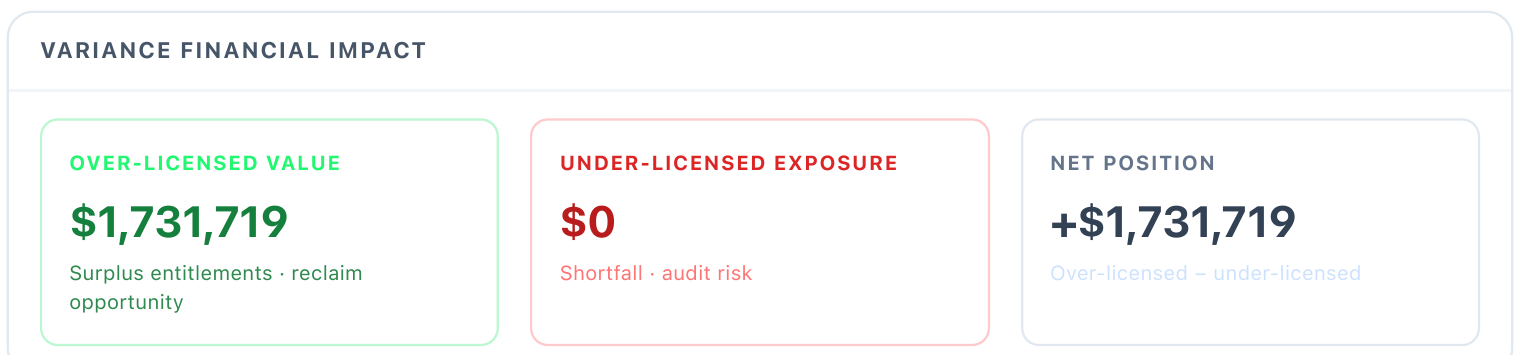
The reconciliation a quarterly audit team used to spend weeks on, standing as a live dollar figure.
Shown: XOPS Asset Intelligence, product demo.
Choose one publisher, renewal, or lifecycle event. Connect the relevant systems. Establish the Software Position and run one real Outcome before the next steering meeting.